
Elephant poop coffee (often sold under the name Black Ivory Coffee) is one of those coffee topics that sounds like a joke—until you realize it sits at the intersection of food science, luxury coffee culture, and ethical purchasing. If your audience is U.S.-based home brewers (the kind of readers who browse coffeemakerusa.com to choose a brewer, grind size, or bean type), it’s worth understanding because this coffee is mostly about experience: flavor smoothness, rarity, and the story behind the cup—not “miracle” health claims.
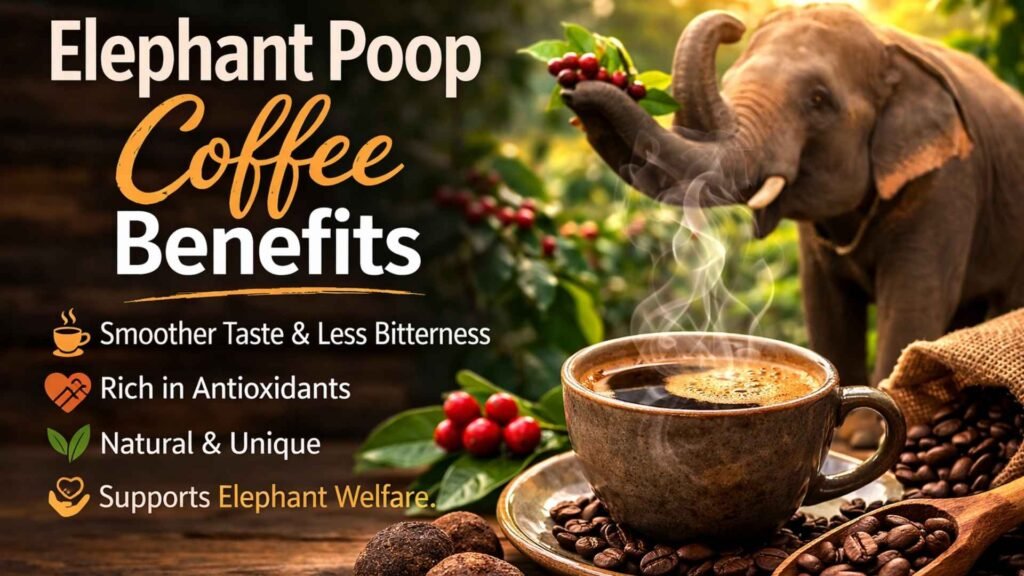
Elephant poop coffee’s “benefits” are mainly sensory and experiential: it can taste smoother and less bitter than many regular coffees because digestion changes certain compounds before roasting. It may also appeal to buyers who value social impact when sourced responsibly. Health-wise, it’s still coffee—so any health perks are the same general benefits linked to coffee polyphenols and moderate caffeine intake, not something uniquely proven for elephant-digested beans.
Elephant poop coffee benefits: what’s real, what’s hype
Before we get into “benefits,” here’s the most helpful framing for readers:
- Realistic benefits = flavor, smoothness, low-bitter profile, rarity, conversation value, and (sometimes) social responsibility.
- Overhyped benefits = claims that it’s dramatically “healthier” than normal coffee (evidence doesn’t support unique health superiority).
Smoother taste and lower bitterness (the #1 reason people buy it)
The main “benefit” people notice is reduced bitterness.
Why? Two mechanisms show up in research and reporting:
- Protein breakdown: bitterness is partly linked to proteins and how they transform during processing/roasting; digestion may reduce bitterness-related components.
- Microbiome + pectin pathways: a Scientific Reports study suggests elephants producing Black Ivory Coffee had gut microbes enriched with enzymes involved in breaking down plant components like pectin, potentially influencing compounds that contribute to bitter notes after roasting.
“When an elephant eats coffee, its stomach acid breaks down the protein found in coffee, which is a key factor in bitterness.”
More “tea-like” complexity (especially with gentle brewing)
Black Ivory’s producer describes it as delicate and “almost tea-like” with notes such as chocolate/cacao and spice. That matters to your audience because brewing method can either highlight or flatten those subtleties.
Best brew styles for highlighting “smooth” coffees
- Pour-over (V60, Kalita): clarity + aroma
- Siphon: clean, aromatic cup (often recommended for showy, luxury coffees)
- Filtered drip: easiest for home users—use quality water + correct dose/grind
“Gentler” drinking experience (but don’t overpromise)
Some people describe smooth, lower-bitter coffees as “easier” to drink black. That’s a sensory benefit, not a medical claim. If someone has reflux or sensitivity, the safest advice is still: test your tolerance and follow caffeine guidance.
Social-impact value (when sourced responsibly)
A meaningful “benefit” for many buyers is the impact story—supporting elephant caregivers and local students involved in washing/drying the beans.
Some partners state that 8% of sales are donated to the Golden Triangle Asian Elephant Foundation. (Readers should still verify seller claims, because “elephant coffee” is often used in marketing.)
Rarity, gifting, and “bucket list” appeal
For many coffee lovers, elephant poop coffee is like buying:
- a rare bottle of whiskey,
- a limited microlot gesha,
- or a luxury tasting flight.
It’s less about daily drinking and more about trying something almost no one has tried.
How elephant dung coffee is made (Black Ivory Coffee process)
Understanding the process makes the “benefits” more believable—and helps readers judge safety and ethics.
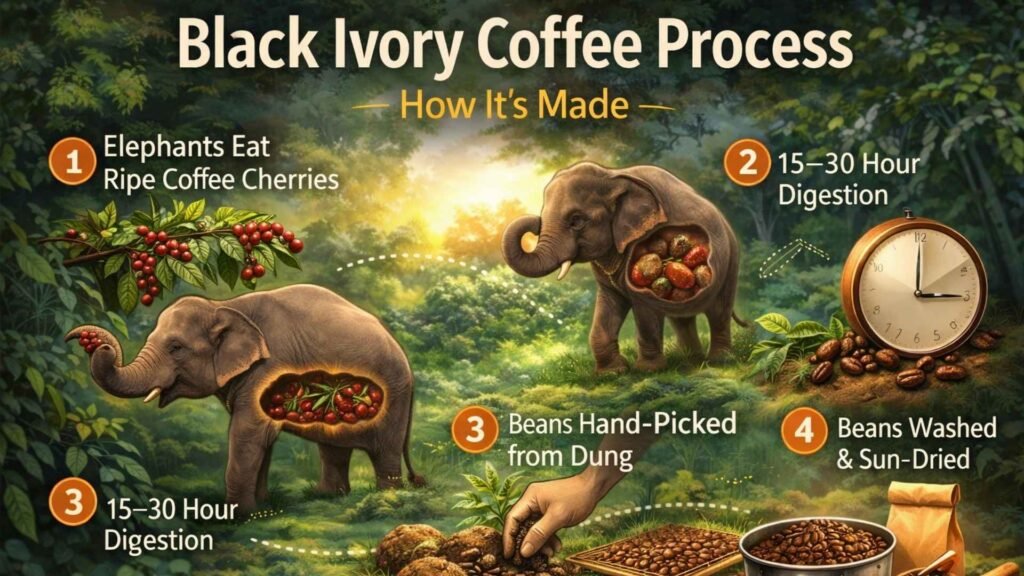
Step-by-step: from cherry to cup
- Ripe Arabica coffee cherries are eaten by elephants (as part of a broader diet).
- Digestion takes ~15–30 hours, during which fermentation and enzymatic changes can occur.
- Cherries/beans are collected after excretion and hand-picked.
- Beans are washed, raked, and sun-dried, then hulled and sorted.
- Finally, they’re roasted and packed (often roast-to-order).
Why it’s so expensive (the 33:1 ratio)
A major reason for the price is simple inefficiency: it takes about 33 kg of coffee cherries to produce 1 kg of finished Black Ivory Coffee.
Is elephant poop coffee safe to drink?
This is a top reader concern—and it deserves a clear, practical answer.
The common-sense safety explanation
While the beans start in an unusual place, reputable producers describe multiple controls:
- collection + washing
- sun-drying to target moisture
- roasting (high heat)
- sealed packaging
What buyers should do (practical checklist)
Buy safely
- Choose known producers/partners with transparent process info.
- Avoid “too cheap to be true” listings—rarity is part of the product.
Brew safely
- Use clean equipment, filtered water, and store beans properly (cool, dry, airtight).
Health and wellness: what benefits are actually supported?

If your readers are searching “elephant poop coffee benefits,” some are hoping for “health hacks.” Here’s the honest, research-aligned take:
It still contains coffee’s natural bioactives
Coffee is known for plant compounds like polyphenols (including chlorogenic acids), which are part of why coffee is studied for health associations.
Caffeine benefits and limits still apply
For most healthy adults, the FDA cites 400 mg/day as an amount “not generally associated with negative effects.”
An 8-oz brewed coffee is often cited around ~95 mg caffeine, though it varies by bean and brew.
Bottom line: elephant poop coffee isn’t proven to be uniquely healthier—it’s mainly a luxury flavor experience.
Ethics: the big question behind “animal-processed coffee”
A coffee can taste amazing and still raise ethical issues. Your readers will respect you for addressing this directly.
What “ethical sourcing” looks like here
Look for signs that:
- elephants are not forced into harmful feeding practices,
- coffee cherries are a small part of a broader diet,
- and funds support care and local communities.
Why this matters (a quick comparison)
Animal-processed coffees vary widely in ethics. For example, civet coffee (kopi luwak) has documented welfare concerns in many supply chains—so readers should apply extra scrutiny to any “animal coffee,” including elephant coffee.
Brewing tips for home coffee makers
This is where coffeemakerusa.com can shine: most people who buy rare coffee accidentally brew it like a generic dark roast and miss the point.
Recommended recipe (easy + consistent)
Goal: a clean, smooth cup that highlights aromatics.
- Method: pour-over or high-quality drip
- Ratio: 1:16 (e.g., 20g coffee to 320g water)
- Water temp: 195–205°F
- Grind: medium (like sea salt)
- Brew time: ~2:30–3:30 (pour-over), or standard drip cycle
Dial-in guide (micro adjustments)
If it tastes flat
- grind slightly finer
- increase dose slightly
If it tastes bitter or dry
- grind slightly coarser
- reduce brew time (or agitation)
If it tastes sour
- raise temperature slightly
- extend contact time a bit
Quick comparison table: elephant poop coffee vs other options
| Feature | Elephant poop coffee (Black Ivory) | Specialty washed Arabica | Kopi luwak (civet coffee) |
|---|---|---|---|
| Main appeal | Smooth, low-bitter, ultra-rare story | Clean terroir + craft processing | “Animal-processed” novelty |
| Why it tastes different | Digestion + fermentation + microbiome effects | Fermentation method + roast profile | Animal digestion/fermentation |
| Availability | Extremely limited; luxury venues | Widely available | Varies; sourcing can be unclear |
| Ethics questions | Must verify welfare & transparency | Usually easier to verify | Often higher risk supply chain concerns |
| Best brewing | Pour-over, siphon, filtered drip | Any method | Depends heavily on roast & freshness |
FAQs
What are the main benefits of elephant poop coffee?
Smoother taste, lower bitterness, and a rare “bucket list” coffee experience. Some buyers also value the social-impact story when purchased through transparent sources.
Does elephant poop coffee have unique health benefits?
Not proven. It’s still coffee, so it may share the general benefits associated with coffee polyphenols and moderate consumption—but it’s not uniquely validated as “healthier.”
Why is it less bitter than regular coffee?
Reports cite protein breakdown during digestion, and research suggests gut microbes may break down compounds (like pectin-related pathways) that influence bitterness after roasting.
Is elephant dung coffee safe to drink?
Reputable producers describe washing, drying, and roasting steps that support food safety. Buy from transparent sellers and avoid suspiciously cheap listings.
What does Black Ivory Coffee taste like?
It’s often described as smooth and delicate, with notes like chocolate/cacao and spice. Taste varies by roast and brewing method.
How much caffeine is “safe” per day for most adults?
The FDA cites 400 mg/day as an amount not generally associated with negative effects for most adults (individual tolerance varies).
Why is elephant poop coffee so expensive?
Production is extremely inefficient—about 33 kg of cherries for 1 kg of coffee—plus labor-intensive collection, washing, sorting, and limited supply.
How should I brew it at home?
Use a clean, gentle method like pour-over or filtered drip, medium grind, and a balanced ratio (around 1:16). Avoid over-extraction so the cup stays smooth.
Is elephant poop coffee ethical?
It depends on the producer. Look for transparency, welfare-first practices, and documented community/elephant support. Some partners state that proceeds support elephant foundations—verify these claims before buying.
Is it worth buying?
If you love rare coffees and want a memorable tasting experience, maybe. If you want “best flavor per dollar,” a top-tier specialty Arabica will usually be a smarter everyday choice.
Elephant poop coffee benefits are best understood as flavor + experience benefits: a smoother, less bitter cup with a fascinating production story and (sometimes) a social-impact angle—especially when sourced through transparent channels. Science increasingly supports the idea that elephant digestion and gut microbes can influence bitterness-related compounds, but health claims beyond normal coffee aren’t uniquely proven. Brew it gently, buy it carefully, and treat it like the luxury tasting it is.