
Understanding the Mushroom Coffee & Dialysis
In recent years, mushroom coffee has become a popular alternative to traditional coffee in the United States. Unlike regular coffee, mushroom coffee blends real coffee with medicinal mushroom extracts like lion’s mane, reishi, cordyceps, and chaga — touted for potential benefits ranging from immune support to reduced caffeine dependence.
For people on dialysis — who must carefully monitor fluid intake, electrolytes like potassium and phosphorus, and sometimes caffeine — the question isn’t just “Is it trendy?” but “Is it safe and beneficial for my kidneys and overall health?”
This is especially important because dialysis patients have uniquely restrictive diets and fluid limits that differ from general kidney disease recommendations.

Dialysis isn’t just a treatment — it’s a complex, lifelong regimen. What patients drink directly affects:
- Fluid balance (too much fluid may cause swelling or cardiac issues)
- Electrolytes (imbalances can trigger arrhythmias)
- Kidney burden (even though dialysis takes over the filtration role)
For any beverage — including specialty coffees — the stakes are higher. Many people assume “natural” drinks are inherently safe, but for dialysis patients, each ingredient matters medically, not just culinarily.
Mushroom Coffee & Dialysis: Is It Safe?
The Short Answer
Maybe — but only with medical oversight and personalized adjustments.
Dialysis patients can sometimes consume coffee in moderation, but that guidance is based mainly on regular coffee, not mushroom blends. Black coffee is generally low in potassium and phosphorus, and fluid allowances can include coffee — but strict limits still apply.
What Makes Mushroom Coffee Different
Mushroom coffee isn’t just coffee — it contains medicinal mushroom extracts that introduce compounds not found in traditional coffee. These can include:
- Polysaccharides and antioxidants
- Adaptogens (thought to help with stress response)
- Potentially high oxalates in some varieties (like chaga), which can pose kidney stone risks and may be tricky for kidney patients.
These additional compounds might interact with other medications or affect digestion, which is something dialysis patients need to evaluate with their care team.
Key Considerations for Dialysis Patients
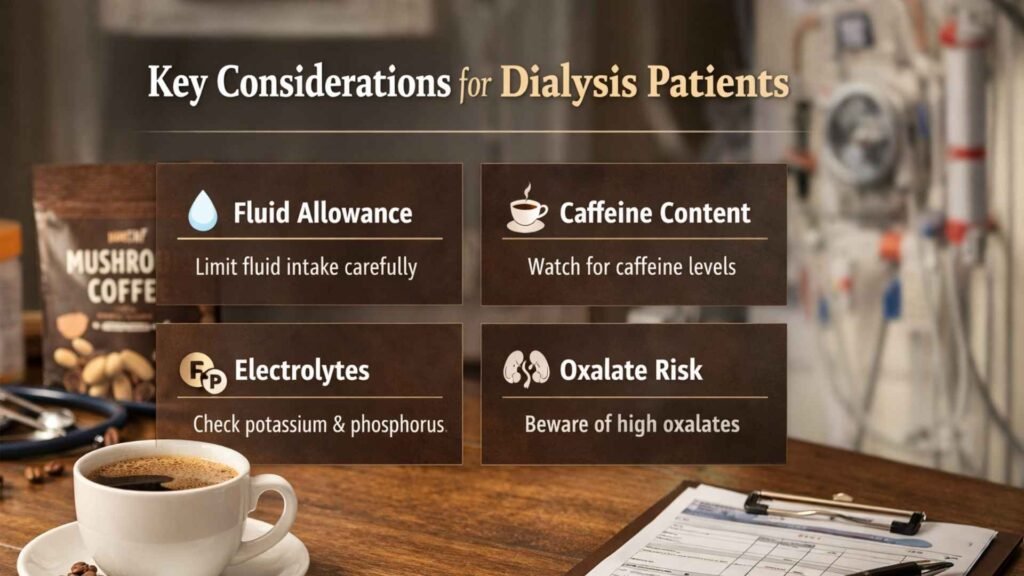
1. Fluid Allowance
Patients on dialysis often have a fluid restriction because kidneys no longer effectively remove excess fluid. Coffee — including mushroom coffee — contributes to your total fluid intake, so it must be counted carefully.
2. Caffeine Content
Most mushroom coffees have less caffeine than regular coffee, but they still contain caffeine, unless labeled decaf. For some dialysis patients, reducing caffeine is beneficial — but for others, even small amounts can affect blood pressure or sleep.
3. Electrolyte Considerations
While black coffee generally has low potassium and phosphorus, additives (like creamer) can raise these dramatically — a major concern for dialysis diets. Mushroom extracts themselves typically don’t add significant electrolytes, but exact content can vary by brand.
4. Oxalates & Kidney Stone Risk
Some medicinal mushrooms (especially chaga) are high in oxalates — compounds that can contribute to kidney stones in susceptible individuals. For dialysis patients with residual kidney function or stone history, this is worth discussing with a nephrologist.
Mushroom coffee might be safe for some dialysis patients in small amounts and with strict monitoring. But it’s not universally “kidney-friendly” by default. Before including mushroom coffee in your routine:
✔ Discuss with your nephrologist or renal dietitian
✔ Review your fluid allowance
✔ Check for additives that increase potassium/phosphorus
✔ Monitor for any reactions or discomfort

FAQs — What Dialysis Patients Really Want to Know
Can all dialysis patients drink mushroom coffee?
Not necessarily — it depends on fluid limits, medications, and individual health status.
Is mushroom coffee better than regular coffee for dialysis?
Not always — it may have lower caffeine, but other constituents (like oxalates) make its safety less clear.
How much mushroom coffee is too much?
In most dialysis diets, fluid is limited. Even one cup must be counted — and your care team should advise exact limits.
Can mushroom coffee affect my dialysis treatment?
High fluid intake or certain compounds might affect blood pressure or electrolyte balance during dialysis.
Are there kidney-friendly mushroom coffees?
Look for brands that state caffeine content, no added potassium/phosphorus additives, and transparent mushroom extract sources.
Can I drink decaf mushroom coffee?
Decaf versions lower caffeine concerns but don’t automatically make it safe — fluid and extract content still matter.
Will mushroom coffee help my kidneys?
There’s no strong evidence that mushroom coffee improves kidney function — benefits are mostly general wellness claims.
Should I count mushroom coffee as part of my daily fluid intake?
Yes — all beverages count toward fluid limits on dialysis.
Can mushroom coffee cause side effects for dialysis patients?
Some people may experience nausea, digestive issues, or interactions with medications — always start small and consult a doctor.
Does mushroom coffee affect blood pressure?
Caffeine and adaptogenic compounds can influence blood pressure, so monitor levels if you choose to drink it.
Are specific mushrooms safer than others for kidney health?
Some experts suggest lion’s mane and reishi might be gentler than chaga — but dialogue with your physician is key.
Can I mix mushroom coffee with milk or cream?
Be cautious — dairy or creamers can add potassium and phosphorus that may be problematic for dialysis diets.
Mushroom Coffee & Dialysis — Intake + Risk Calculator
This tool helps dialysis patients estimate how mushroom coffee might fit into their daily fluid limit, caffeine exposure, and additive-related electrolyte risks. It is not medical advice.
1) Enter your plan + your drink details
Counts coffee as fluid ✔⚠️ If you have symptoms (shortness of breath, swelling, chest pain, severe palpitations), contact your clinic/emergency care.
2) Results
—Total mushroom coffee fluid
Includes additives as fluid (conservative)
Fluid remaining after plan
Based on your daily limit
Total caffeine today (from mushroom coffee)
—
Overall risk estimate (informational)
—
Enter inputs and press Calculate
This tool flags common dialysis concerns: fluid limit, caffeine sensitivity, additives, and chaga/oxalate caution.
Key reminders (dialysis-focused)
- All beverages count toward your daily fluid limit.
- Additives (milk/creamers) can raise potassium/phosphorus depending on product.
- Caffeine may affect blood pressure, heart rhythm, and sleep.
- Chaga is often discussed for higher oxalate content—ask your nephrologist/dietitian if it’s appropriate.
Consider showing these results to your renal dietitian for personalized guidance.
Helpful Resources for Further Reading
📌 National Kidney Foundation – Coffee & Kidney Disease
https://www.kidney.org/news-stories/coffee-and-kidney-disease-it-safe


0 Comments