Home brewers, casual coffee drinkers, and shoppers trying to buy with confidence—this topic matters because food rumors spread fast, and coffee is something many people use every day. When a claim like “Nescafe coffee contains cockroaches” starts circulating online, it can sound alarming enough to change what people buy, serve, or recommend. The good news is that this question has a clearer, more factual answer than the internet usually gives it.
No—there is no credible evidence that NESCAFÉ contains cockroaches as an ingredient. Official NESCAFÉ information says major products such as NESCAFÉ CLÁSICO, TASTER’S CHOICE, and GOLD ESPRESSO contain 100% pure instant coffee, while certain flavored items and espresso concentrates include other listed ingredients like sugar, natural flavor, or baking soda. The confusion comes from FDA guidance on unavoidable insect-related defects in agricultural foods, which is very different from saying a brand intentionally puts cockroaches into coffee.
Is There Cockroach Contamination in Nescafé Coffee?
The most accurate answer is this: NESCAFÉ is not marketed or labeled as containing cockroaches, and official brand information does not list cockroaches as an ingredient. What people are usually referring to is a broader food-safety reality—coffee is an agricultural product, and regulators recognize that tiny, unavoidable insect-related defects can sometimes occur somewhere in the supply chain. That is not the same as saying “NESCAFÉ has cockroaches in it.”
What NESCAFÉ actually contains
According to the official NESCAFÉ US FAQ, NESCAFÉ CLÁSICO, NESCAFÉ TASTER’S CHOICE, and NESCAFÉ GOLD ESPRESSO contain 100% pure instant coffee. The same FAQ also explains that some flavored products or espresso concentrates contain additional ingredients such as caramelized sugar, natural flavor, or baking soda. None of the official ingredient information identifies cockroaches or insect matter as an ingredient.
Where the cockroach rumor comes from
The rumor usually starts when people read about FDA defect guidance for coffee and then oversimplify it into a viral claim. The FDA does discuss insect contamination in coffee at the commodity and inspection level, especially for green coffee beans, because coffee is a raw agricultural product that can be exposed to pests before roasting and processing. But regulatory defect language is not the same thing as an ingredient statement for a finished retail brand.
What the FDA actually says about coffee defects
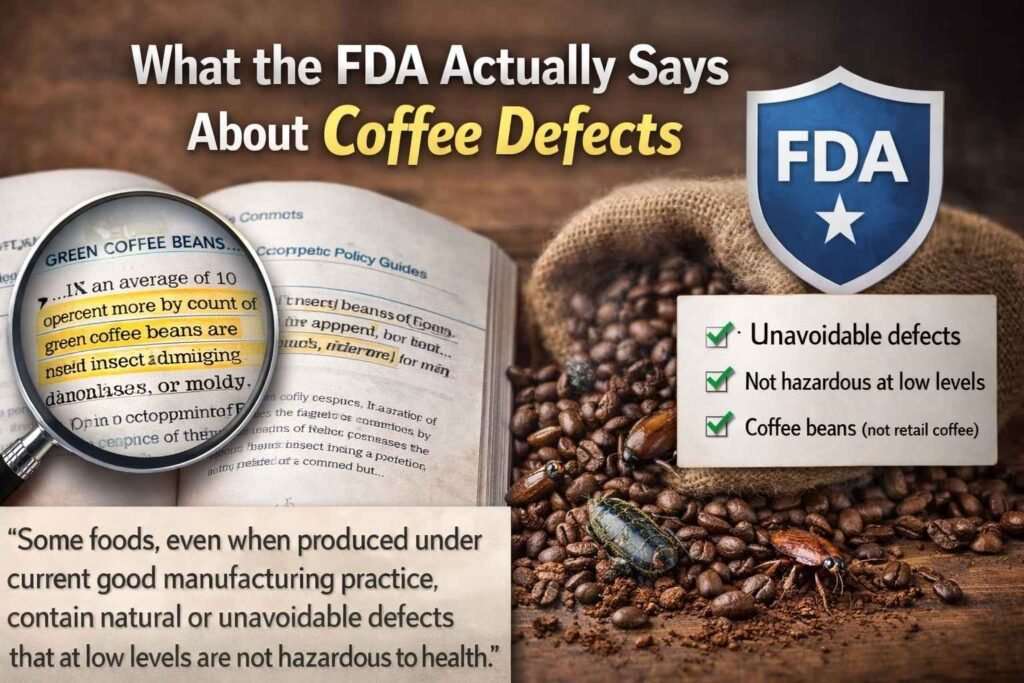
The FDA’s Compliance Policy Guide for green coffee beans says regulatory action may be considered when “an average of 10 percent or more by count of green coffee beans are insect infested, including insect damaged, or moldy.” That wording matters. It refers to green coffee beans, and it refers to insect infestation or insect damage, not “10% cockroaches in your jar of instant coffee.”
“Some foods, even when produced under current good manufacturing practice, contain natural or unavoidable defects that at low levels are not hazardous to health.”
That FDA statement is the key to understanding the issue correctly. Regulators are acknowledging that some low-level defects can occur in real-world food production, not giving brands permission to formulate products with insects.
Why “10% cockroaches in coffee” is misleading
There are three common distortions in the online version of this story:
The internet myth vs the actual wording
- Myth: “The FDA allows 10% cockroaches in coffee.”
- Fact: The FDA action threshold is about green coffee beans that are insect-infested or insect-damaged, not a finished jar being 10% cockroach material.
- Myth: “NESCAFÉ contains bugs as an ingredient.”
- Fact: Official NESCAFÉ ingredient information says several leading instant products are 100% pure instant coffee.
- Myth: “This only applies to Nescafe.”
- Fact: FDA defect guidance is written around food commodities and unavoidable defects generally, not around one single coffee brand.
Whole insects, insect damage, and fragments are not the same thing
Another reason the rumor gets exaggerated is that people merge very different ideas into one scary headline. A bean that is insect-damaged is not the same thing as a finished product containing visible insects. The FDA handbook and coffee inspection methods cover issues like insect infestation, insect damage, mold, and other extraneous matter in raw materials and lots under inspection. That technical language is about quality control and enforcement thresholds—not proof that retail NESCAFÉ coffee is packed with cockroaches.
Are there insect fragments in instant coffee like Nescafé?
The honest, research-based answer is more nuanced than a yes-or-no headline. It is possible for agricultural foods, including coffee, to have tiny unavoidable defects somewhere in the production chain, and the FDA explicitly says low levels can exist without creating a health hazard under current good manufacturing practice. But that does not validate the claim that NESCAFÉ “contains cockroaches” in the way most readers understand that phrase.
Instant coffee still starts with coffee beans
NESCAFÉ’s own FAQ explains that its instant coffee is made from coffee beans that are extracted and then dried. For example, it says CLÁSICO is spray-dried and TASTER’S CHOICE is freeze-dried after extraction. That means instant coffee still begins with the same agricultural raw material—coffee beans—that food regulators inspect for defects before products reach consumers.
Does the FDA mention Nescafé by name?
No. The FDA materials referenced here discuss coffee beans, food defects, and general adulteration standards. They do not identify NESCAFÉ as a product that contains cockroaches. So if someone claims “the FDA says Nescafé has cockroaches,” that wording goes beyond what the source actually says.
What reputable manufacturing and quality control mean here
Nestlé says quality and safety are a top priority across its food and beverage portfolio and describes an end-to-end approach involving supplier qualification, audits, Good Manufacturing Practices, HACCP-based controls, and analytical testing. That does not prove zero defects in every food system on earth, but it does show that a major manufacturer is operating within structured food-safety and quality-control systems rather than casually ignoring contamination risks.
What the FDA says about bugs in coffee
A better phrase than “cockroaches in Nescafe” is “FDA defect levels for coffee.” That framing gets closer to the truth.
FDA coffee defect action levels in plain English
The FDA’s handbook and compliance guide show that coffee is regulated like other agricultural products: inspectors look for contamination, set action thresholds, and can recommend action when defects are too high. In coffee, the cited defect threshold concerns green coffee beans averaging 10% or more insect-infested or insect-damaged beans, or moldy beans, under the applicable guidance.
Why this does not equal a consumer-facing ingredient
A regulatory threshold is not a recipe. It is a line used to decide when food may be adulterated or when enforcement may be appropriate. That is why it is misleading to convert a technical FDA threshold into a consumer statement like “Nescafe has cockroaches in it.” The two ideas are simply not the same.
Quick fact table
| Claim | What the evidence says | What it really means |
|---|---|---|
| Nescafe contains cockroaches | Official NESCAFÉ ingredient information does not say that | The claim is not supported by the brand’s product information |
| FDA allows 10% cockroaches in coffee | FDA guidance refers to green coffee beans that are insect-infested or insect-damaged | This is a raw-material inspection threshold, not a formula for instant coffee |
| Tiny unavoidable defects can occur in food | Yes, the FDA says some foods may contain low-level unavoidable defects | That is a food-regulation reality, not proof of intentional contamination |
| This issue is unique to Nescafe | No | FDA guidance applies to food commodities and manufacturing realities broadly |
Sources: NESCAFÉ US.
Should you stop drinking Nescafe?

For most readers, the evidence does not support panicking or writing off the brand based on the viral claim alone. A more sensible conclusion is that NESCAFÉ is a mainstream instant coffee brand made from coffee beans and processed under commercial food-safety systems, while the FDA separately recognizes that some low-level, unavoidable defects can exist in agricultural foods. Those are two different realities, and combining them into “Nescafe contains cockroaches” is an inaccurate shortcut.
Practical ways to buy with confidence
If you want peace of mind as a consumer, focus on practical quality habits rather than viral myths:
Smart buyer checklist
- Buy sealed products from reputable sellers.
- Avoid jars or packets with damaged seals, tears, moisture, or obvious infestation.
- Store coffee in a clean, dry place after opening.
- Use the manufacturer’s customer-service channels if a product looks off or compromised.
FAQs: The Truth About Cockroaches in Nescafé Coffee
1) Does NESCAFÉ list cockroaches as an ingredient?
No. Official NESCAFÉ US product information says major instant products such as CLÁSICO, TASTER’S CHOICE, and GOLD ESPRESSO contain 100% pure instant coffee.
2) Does the FDA allow cockroaches in coffee?
Not in the way viral posts suggest. FDA guidance discusses insect-infested or insect-damaged green coffee beans and uses action thresholds for enforcement decisions.
3) Is the “10%” number about finished Nescafe jars?
No. That figure refers to green coffee beans under FDA compliance guidance, not a retail jar of NESCAFÉ instant coffee.
4) Can coffee have tiny unavoidable insect-related defects?
Yes. The FDA says some foods can contain low-level unavoidable defects under current good manufacturing practice without being hazardous to health.
5) Does this rumor apply only to Nescafe?
No. The underlying FDA discussion is about agricultural foods and coffee beans generally, not only one brand.
6) Is instant coffee made differently from regular ground coffee?
Yes. NESCAFÉ says its instant products are made by extracting coffee and then drying it, including spray-drying or freeze-drying depending on the product.
7) Are all NESCAFÉ products just black coffee?
Not all. Several products are 100% pure instant coffee, while some flavored products and espresso concentrates contain additional listed ingredients.
8) Does the FDA name Nescafé in its coffee defect guidance?
No. The FDA materials cited here discuss coffee beans, food defects, and adulteration standards—not NESCAFÉ by name.
9) Should consumers be worried?
The evidence supports being informed, not alarmed. The viral claim is overstated; the more accurate issue is regulated, low-level unavoidable defects in agricultural food systems.
10) What should I do if my coffee package looks contaminated?
Do not use it. Keep the packaging, document the issue, and contact the seller or manufacturer through official support channels. Nestlé says it maintains consumer-service channels for questions and concerns.
Final summary
So, Are There Insects in Nescafé Coffee? No—not as an ingredient, and not in the way the internet rumor suggests. The validated explanation is that NESCAFÉ’s official product information describes its core instant coffees as pure coffee, while FDA guidance separately acknowledges that agricultural foods such as coffee can have low-level unavoidable defects and sets action thresholds for raw-material inspection.
The claim becomes misleading when technical food-regulation language gets turned into a dramatic headline about “cockroaches in Nescafe.” For a consumer-facing blog post, the fairest conclusion is this: the rumor is exaggerated, the regulatory context is real, and precision matters.



0 Comments